
I know what it’s like to walk into your living room and feel your shoulders tense up at the mess.
You just cleaned yesterday. Maybe even this morning. But somehow there are toys everywhere, backpacks dumped by the door, and you can’t remember the last time you saw your kitchen counter.
It’s exhausting.
Here’s the thing: you’re not failing at keeping your home organized. The systems you’re using just weren’t built for real family life.
I’ve spent years figuring out what actually works for household organizing ewmagfamily situations. Not the pretty Instagram solutions that fall apart the second your kids get home from school. Real strategies that hold up when life gets messy.
This article gives you simple systems you can start using today. No massive overhauls or expensive storage solutions required.
We understand what parents are dealing with because we talk to families every day. We test these methods in actual homes with actual kids who leave actual messes.
You’ll learn how to set up organization systems that your whole family can maintain. Even on the chaotic days.
Your home won’t look like a magazine spread. But it will feel calmer. And you’ll stop spending your evenings picking up the same stuff over and over.
The Foundation: Master the 5-Minute Family Reset
You know that feeling when you walk into your living room and there’s stuff everywhere?
Shoes by the couch. Backpacks on the floor. Random toys that somehow migrated from the playroom.
It happens in every house in Duluth. Probably every house everywhere.
Most organizing advice tells you to do a big weekend overhaul. Spend hours sorting and cleaning until everything’s perfect.
But here’s what actually happens. You spend your whole Saturday cleaning. By Tuesday, it’s a mess again. Then you feel like a failure.
I’m going to show you something different.
The 5-Minute Reset.
It’s exactly what it sounds like. Five minutes. That’s it.
Here’s how it works. Pick one time every day when everyone’s home. For us, it’s right before bed (around 8:30 pm, after the kids have brushed their teeth but before story time).
Set a timer. Everyone scatters and puts things back where they belong.
Not where they think things should go. Where they actually live.
Age-appropriate tasks make this work. My toddler can toss blocks into a bin. My seven-year-old clears the kitchen counter and wipes it down. My ten-year-old handles books and papers.
The key is designated homes for everything. If your kid doesn’t know where something goes, they can’t put it away. Simple as that.
Some parents say this won’t work because their kids are too young or too busy. They think household organizing ewmagfamily style requires more time and structure.
But that’s the beauty of it.
Five minutes is short enough that nobody can complain. Even on hockey practice nights or when we’re running late, we can squeeze in five minutes.
What actually happens: Small messes don’t pile up into big ones. Your house stays mostly tidy without spending your whole weekend cleaning.
And your kids? They start to see that keeping things neat isn’t some huge project. It’s just part of the day.
Like brushing teeth or putting on shoes.
Strategic Zoning: Conquering High-Traffic Areas
Taming the Entryway ‘Drop Zone’
Your entryway is lying to you.
It looks innocent enough. Just a small space by the door. But somehow it becomes the black hole where everything you own ends up in a pile.
Shoes scattered everywhere. Bags dumped on the floor. Mail stacked in random corners. Keys that vanish the second you need them.
I’m going to be honest with you. This isn’t a storage problem. It’s a system problem.
Most people think they just need to be tidier. They beat themselves up about it. But here’s what I believe: if your family keeps dropping stuff in the same spot, that’s where the storage needs to be.
Stop fighting it. Work with it instead.
Here’s what actually works.
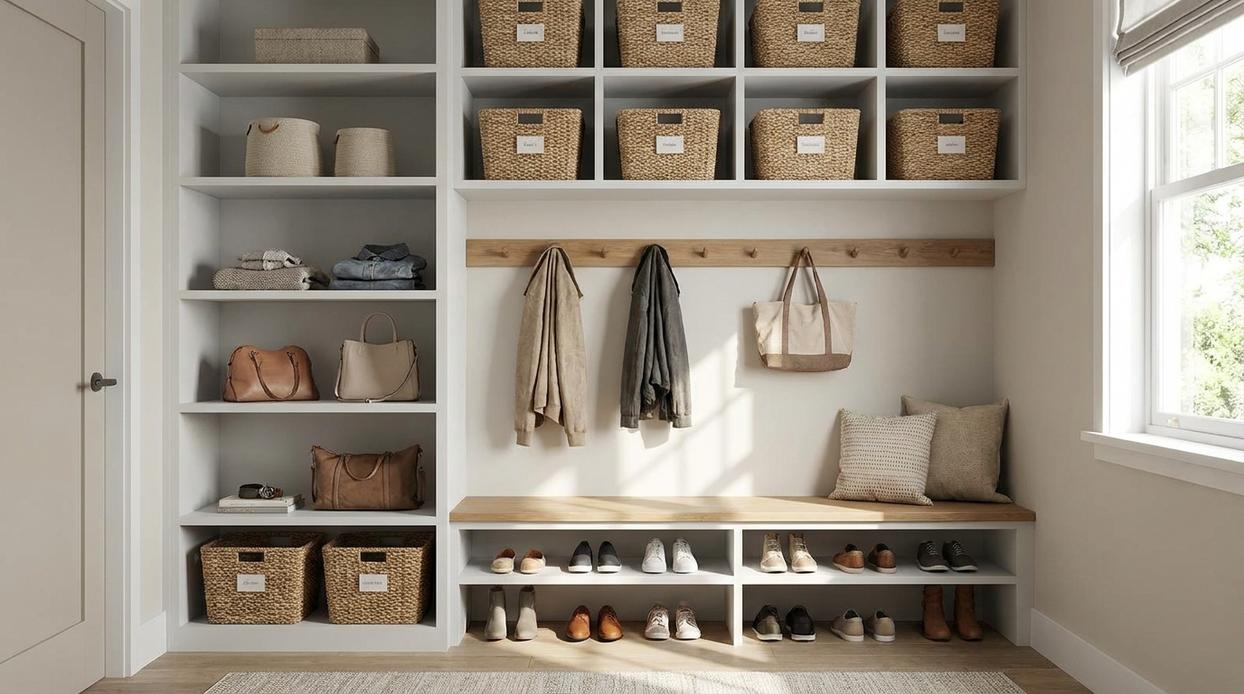
Create a command center right where people naturally drop things:
• Install hooks at different heights so everyone can reach their own
• Put a shoe tray or cubby system RIGHT by the door (not in a closet down the hall)
• Add a small bowl or dish for keys and wallets
• Get a simple mail sorter with three slots: urgent, bills, and trash
The key is making it easier to put things away than to drop them on the floor.
And yes, it needs to look decent. Because if it’s ugly, nobody will use it.
The Living Room & Playroom System
Let me tell you something that might sound harsh.
Your kids don’t need access to every toy they own at the same time.
I know. Some parenting experts will disagree with me on this. They say kids should have freedom to choose whatever they want to play with. That limiting options stifles creativity.
But you know what really stifles creativity? A room so packed with toys that your kid can’t even see what they have.
I’ve watched this play out in my own home. When we had everything out, my kids would wander around saying they were bored. Surrounded by hundreds of toys and claiming there was nothing to do.
Then we tried something different.
We created what I call a toy library:
• Use cube storage with large bins that kids can actually lift
• Label everything with pictures AND words
• Keep only 30% of toys out at any given time
• Rotate them every week or two
The rest? Store them somewhere else entirely.
This is basic household organizing ewmagfamily strategy. Less visible clutter means less mental load for everyone.
And here’s the part that surprised me.
My kids started playing LONGER with individual toys. They’d actually finish puzzles instead of dumping three out and walking away. They’d build entire cities with blocks instead of just scattering them.
Turns out, too many choices is just as bad as too few.
The living room stays cleaner too. Because when toys do migrate out of the playroom (and they will), there are fewer of them to deal with. Quick five-minute pickup before bed instead of a 30-minute battle.
Some people say this approach is too controlling. That kids need to learn to manage their own stuff.
Maybe. But I think they need to learn on a scale they can actually handle first.
You wouldn’t hand a six-year-old a closet with 100 shirts and expect them to keep it organized. So why do we do that with toys?
Kid-Friendly Systems They Will Actually Use
I’ve watched too many parents buy expensive organizing systems that end up ignored within a week.
The bins sit empty. The labels get peeled off. And the toys? Still all over the floor.
Here’s what most organizing advice gets wrong. It’s built for adults who already know how to maintain systems. Not for kids who think differently.
Some experts will tell you that kids just need more discipline. That if you enforce the rules strictly enough, they’ll follow any system you create. And sure, you could turn every cleanup into a battle.
But I’d rather work with how kids actually think.
After years of testing different approaches (and stepping on countless LEGOs), I found that kids will use systems when those systems make sense to their brains. Not ours.
The Power of ‘See-Through’ Storage
Kids don’t remember what’s in closed containers.
They just don’t. Which means they’ll dump out every bin in the room looking for that one specific toy car.
Clear plastic bins change this completely. So do open-front wire baskets. When kids can see their building blocks or art supplies or dolls, they know exactly where to put things back.
I started using this method with my own family and the difference was immediate. No more excavation projects in the playroom.
It sounds simple because it is. But most household organizing ewmagfamily resources skip right over this because they’re focused on what looks pretty in photos.
The ‘Grab-and-Go’ Closet
Morning routines shouldn’t feel like negotiations.
But when kids can’t find clean clothes or don’t know what to wear, that’s exactly what happens. You’re already running late and now you’re debating whether stripes match polka dots.
Here’s what worked for me. Get a hanging closet organizer with separate compartments. On Sunday evening, plan out the week’s outfits and put each one in its own slot.
Monday’s outfit goes in the Monday slot. Tuesday in Tuesday. You get it.
Now your kid can get dressed without asking you seventeen questions. They know what to wear and where to find it. Their closet stays organized because everything has a specific spot.
Pro tip: Let them help pick the outfits on Sunday. They’re way more likely to actually wear what they chose themselves.
This isn’t about being controlling. It’s about removing the friction that makes mornings miserable for everyone.
Making It a Habit: Organization as a Family Value
Look, I know what happens.
You spend a Saturday organizing the playroom. Everything has a place. The bins are labeled. It looks perfect.
Then Monday hits and it’s chaos again.
Here’s what most parents don’t realize. Organization isn’t about having the perfect system. It’s about building habits that stick.
Some people say kids are just naturally messy and you should wait until they’re older to teach them. They think structure stifles creativity or that it’s too much pressure.
But that’s not how it works.
Kids actually thrive on routine. They want to know what’s expected. The problem isn’t that they can’t learn to be organized. It’s that we make it too complicated or too boring.
I’ve found three simple approaches that turn tidying up from a chore into something your family ewmagfamily actually does without thinking about it.
Gamify the Tidy-Up
Turn cleaning into something fun. Set a timer and see who can put away the most items before it goes off. Or play ‘I Spy’ for things that are out of place.
My favorite? Put on a high-energy clean-up song. When the music plays, everyone knows it’s go time. (You’d be surprised how fast kids move when there’s a beat involved.)
The ‘One In, One Out’ Rule
This teaches household organizing ewmagfamily principles without the lecture.
When a new toy or piece of clothing comes into the house, your child picks an old one to donate. Simple as that.
It’s a lesson in minimalism they’ll carry forever. Plus it keeps the clutter from taking over your life.
The Always-Ready Donation Box
Keep an open box in a closet somewhere. As soon as you spot something outgrown or unused, toss it straight in the box.
No second-guessing. No “maybe we’ll use it later.”
When it’s full, make a family trip to the donation center together. Kids see where their old stuff goes and why it matters.
Your Path to a More Peaceful, Organized Home
I get it.
You look around your house and see toys everywhere. Shoes by the door. Papers piling up on the counter.
Family life is messy. That’s just how it is.
But here’s what I’ve learned: you don’t need a perfect home. You need systems that actually work for your family.
This guide shows you how to create that kind of home. We’re talking about simple strategies like the 5-minute reset and smart zoning. Things you can actually stick with.
You came here because the daily clutter was wearing you down. I want you to know that feeling doesn’t have to be your normal.
When you set up kid-friendly storage and build small organizational habits, something shifts. Your home starts working with you instead of against you.
Here’s what I want you to do: Pick one tip from this guide. Just one. Try it this week.
Maybe it’s the 5-minute reset before bed. Maybe it’s creating a drop zone by the front door.
Start small and watch what happens.
You’ll see the difference in how your home feels. More than that, you’ll see it in how your family moves through the day.
household organizing ewmagfamily is about making life easier, not harder. You deserve a home that supports you.
 Founder & Vision Director
Vlythra Pell is the visionary founder of EW Mag Family, guiding its mission to support and uplift modern families. Based in Duluth, Minnesota, she combines insight, empathy, and leadership to shape meaningful parenting conversations. With a strong focus on connection and growth, Vlythra curates content that reflects real-life family dynamics. Her work bridges research with everyday practicality, making parenting more approachable. She is deeply committed to building a trusted space for families to learn and grow. Through her direction, the platform continues to evolve as a reliable resource for modern parenting.
Founder & Vision Director
Vlythra Pell is the visionary founder of EW Mag Family, guiding its mission to support and uplift modern families. Based in Duluth, Minnesota, she combines insight, empathy, and leadership to shape meaningful parenting conversations. With a strong focus on connection and growth, Vlythra curates content that reflects real-life family dynamics. Her work bridges research with everyday practicality, making parenting more approachable. She is deeply committed to building a trusted space for families to learn and grow. Through her direction, the platform continues to evolve as a reliable resource for modern parenting.